A Gunner's War by Ian Ronayne
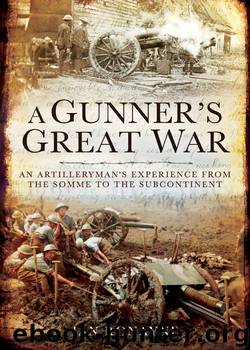
Author:Ian Ronayne [Ronayne, Ian]
Language: eng
Format: epub
ISBN: 9781783461325
Publisher: Pen and Sword
Published: 2013-07-04T16:00:00+00:00
As Clarence had discovered during those August weeks around Ypres, bombing attacks by aircraft had become an increasingly common threat by 1917. The development of military aviation was one of the First World War’s most remarkable aspects, evolving from a handful of primitive flying machines in 1914 to large fleets of aircraft performing a wide range of roles by the end of the conflict. The early aircraft had been attached to army headquarters at the start of the war, for use in reconnaissance and scouting roles. The British Army, for example, had crossed to the continent in August 1914 with just sixty aircraft formed into three squadrons of the recently established Royal Flying Corps, or RFC. Sceptics who questioned the value of military aircraft in those early days were soon proved wrong, however, as reconnaissance missions provided an invaluable insight into the enemy’s location and movement. During the German advance on Paris in the summer of 1914, crucial news about the direction of advancing troops had come from a RFC aircraft, allowing the British and French the opportunity to prepare and launch a counterattack in the right place and at the right time.
With both sides flying reconnaissance over the other’s lines, it was not long before aerial combat started. At first, pilots armed themselves with handguns and took pot shots at enemy planes when they were encountered. Soon, however, planes became armed with machine guns and grouped together into ‘fighter’ squadrons to seek out and shoot down enemy aircraft. The classic image of the heroic ‘fighter pilot’ emerged at this time, with those who scored multiple aerial victories hailed as ‘aces’. For the young men who actually flew and fought in the First World War, the reality of aerial combat was very different however. Sent into battle with only limited training and flying experience, their life expectancy was a short one. Denied a parachute by the belief that it might encourage pilots to abandon the aircraft prematurely, many suffered terrible deaths by burning or falling, having encountered a superior enemy or after simply running out of luck. In total, the RFC and its 1918 successor the Royal Air Force, would lose over 9,000 flyers, killed or missing during the course of the war.
Parallel to the development of the fighter plane was that of the bomber. While fighters were used to attack ground targets on the battlefield with small bombs and machine gun fire, purpose-built bombers capable of carrying increasingly heavy bomb loads and of ranging progressively further distances, struck targets such as military camps, depots and railway stations in the towns and countryside behind the front lines. Often under the cover of darkness to avoid patrolling fighters, the bombers brought a new dimension of threat to previously safe areas. The response was a proliferation of anti-aircraft guns and in places, specially trained night fighters that attempted to intercept the attackers.
German bombers and fighters had done what they could to disrupt preparations for the next phase in the British offensive at Ypres, planned to start on 16 August.
Download
This site does not store any files on its server. We only index and link to content provided by other sites. Please contact the content providers to delete copyright contents if any and email us, we'll remove relevant links or contents immediately.
Waking Up in Heaven: A True Story of Brokenness, Heaven, and Life Again by McVea Crystal & Tresniowski Alex(37925)
Still Foolin’ ’Em by Billy Crystal(36468)
Cecilia; Or, Memoirs of an Heiress — Volume 1 by Fanny Burney(32721)
Cecilia; Or, Memoirs of an Heiress — Volume 2 by Fanny Burney(32089)
Cecilia; Or, Memoirs of an Heiress — Volume 3 by Fanny Burney(32066)
Fanny Burney by Claire Harman(26726)
Empire of the Sikhs by Patwant Singh(23205)
We're Going to Need More Wine by Gabrielle Union(19170)
Hans Sturm: A Soldier's Odyssey on the Eastern Front by Gordon Williamson(18724)
Plagued by Fire by Paul Hendrickson(17540)
Out of India by Michael Foss(17022)
All the Missing Girls by Megan Miranda(16704)
Cat's cradle by Kurt Vonnegut(15556)
For the Love of Europe by Rick Steves(14914)
Pimp by Iceberg Slim(14796)
Molly's Game by Molly Bloom(14260)
Bombshells: Glamour Girls of a Lifetime by Sullivan Steve(14219)
Leonardo da Vinci by Walter Isaacson(13514)
4 3 2 1: A Novel by Paul Auster(12613)
